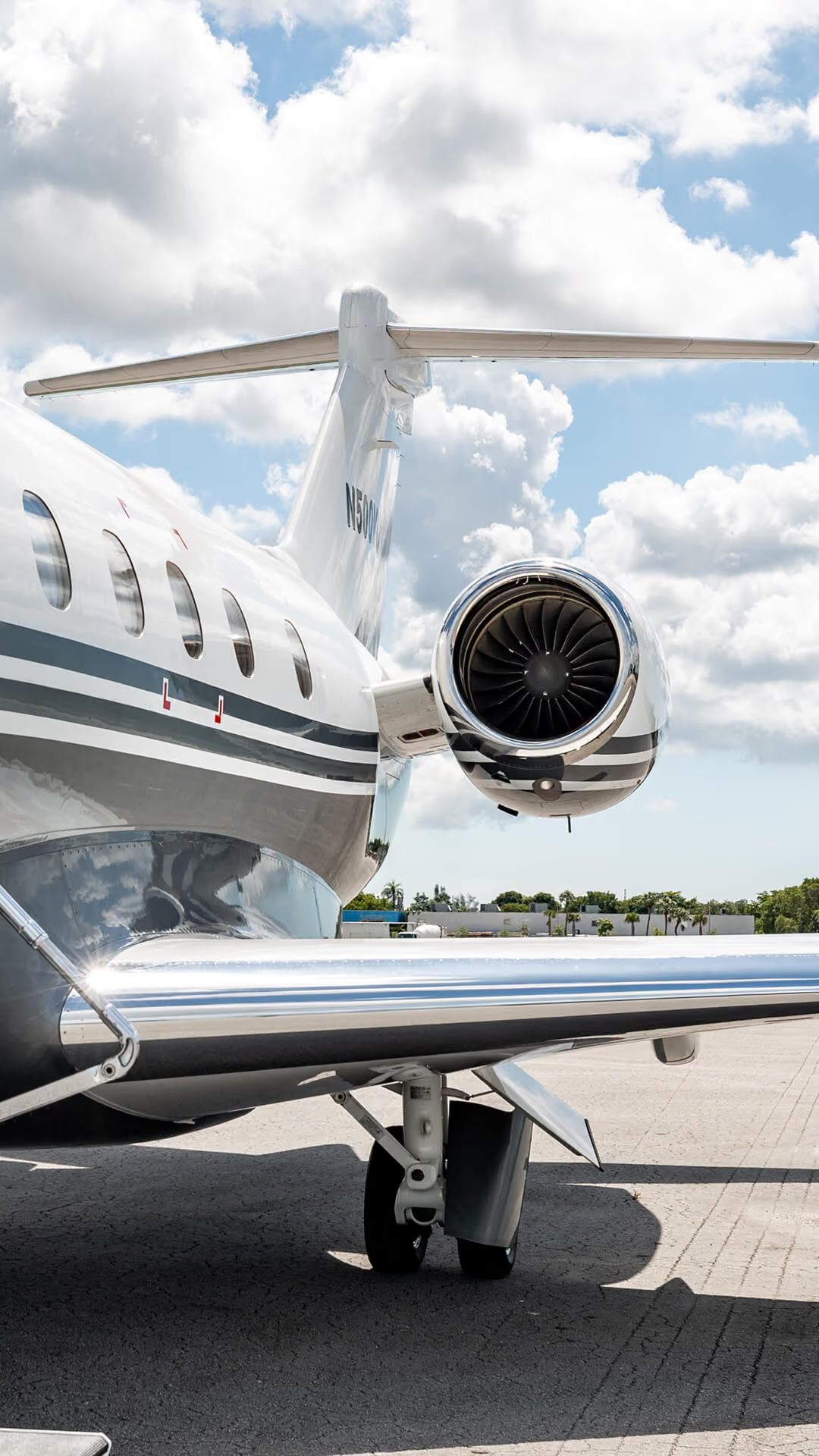
Two of the most talked-about large-cabin jets of the decade come from very different philosophies. The Gulfstream G700 is a flagship built to go farther and carry more people in more comfort than almost anything in business aviation. The Dassault Falcon 6X is a twinjet built around cabin height, runway flexibility and efficiency.
If you are weighing the G700 vs Falcon 6X, this guide compares them on the points that matter to a buyer: range, cabin, cost, and how easy each is to actually get.
G700 vs Falcon 6X at a Glance
| Specification | Gulfstream G700 | Dassault Falcon 6X | Falcon 7X (used reference) |
|---|---|---|---|
| Range | About 7,500–7,800 nm (varies by source and assumptions) | About 5,500 nm | About 5,466–5,950 nm |
| Engines | 2 × Rolls-Royce Pearl 700 (18,250 lbf each) | 2 × Pratt & Whitney Canada PW812D | 3 × PW307A |
| Cabin length | 56 ft 9 in | About 40 ft 4 in | 39 ft 1 in |
| Cabin height / width | 6 ft 3 in / 8 ft 2 in | About 6 ft 6 in / 8 ft 6 in | 6 ft 2 in / 7 ft 7 in |
| Typical passengers | Up to 19 seats, sleeps up to 13 | 12–16 | 12 |
| Estimated price | About $84.9M new | Quote on request | About $24.5M (used market) |
Range and Speed: The G700 Goes Farther
Range is the clearest dividing line. The G700 is an ultra-long-range jet that can link city pairs such as Hong Kong to New York or Los Angeles to Singapore without a fuel stop, depending on payload and winds. The Falcon 6X is a very capable long-range jet, but at roughly 5,500 nm it covers New York to Dubai or Paris to most of Asia only with careful planning.
If you routinely fly 10 to 14 hours, the G700 is built for that. If most of your trips are transatlantic or transcontinental, the 6X covers them comfortably, and you give up range you may never use.
Cabin: Length vs Height
The G700 has one of the longest cabins in business aviation, about 2,603 cubic feet, with up to five living areas, a crew rest compartment, 20 panoramic windows and a low cabin altitude. Its length is the key advantage. It lets you create a true dining room, a full stateroom and a separate lounge without the spaces feeling cramped.
The Falcon 6X answers with a taller and wider cross-section. Standing headroom, a wide aisle and large windows make it feel airy even though it is shorter. Passengers who value volume per person may prefer it. Passengers who value separate rooms will prefer the G700.
Cockpit and Technology
Both aircraft are fly-by-wire. The G700 uses Gulfstream's Symmetry flight deck, with active-control sidesticks, and shares a common type rating with the G500 and G600. Dassault's Falcon family carries its own fly-by-wire heritage; the Falcon 7X was the first fully fly-by-wire business jet. Dassault's twinjet 6X adds modern avionics and strong short-field performance.
For flight departments already operating one manufacturer's aircraft, crew familiarity and training pipelines may carry as much weight as any spec.
Operating Costs: Where Ultra-Long-Range Gets Expensive
Large-cabin ownership is not cheap, and the G700 sits at the top. Using Conklin & de Decker's October 2026 estimates at 150 flight hours a year:
- G700: about $3.13M per year in direct and fixed costs, or about $20,844 per flight hour. Including market depreciation, the annual figure rises to roughly $7.8M, because depreciation on a new aircraft of this value is substantial.
- Falcon 7X (comparable earlier-generation Falcon): about $2.84M per year, or about $18,907 per hour. With depreciation, about $4.18M.
The Falcon 6X typically sits between a 7X and a G700 on acquisition cost. Request a current cost model from your advisor rather than relying on brochure numbers. The depreciation line is where new-aircraft ownership diverges most from used.
Availability: A Real-World Constraint
This is where theory meets the market. According to The Jet Guys market report dated October 7, 2026, the G700 fleet is 120 aircraft in operation with another 68 at the manufacturer, and none were listed for sale. Recorded transactions are almost entirely new deliveries direct from Gulfstream. In practice, buying a G700 means joining a delivery queue or buying a position, not browsing listings.
By contrast, the Falcon 7X market has 26 aircraft for sale out of 297 in operation (8.8%), at an average asking price near $22.7M, with ranges from about $14.5M to $39.9M. Average days on market were about 102 at the time of the report. That depth of inventory gives buyers choice and negotiating room.
Which One Should You Choose?
Choose the G700 if you fly long intercontinental legs regularly, entertain or work in the cabin for many hours, and the budget supports a flagship.
Choose the Falcon 6X if most trips are under about 11 hours, you value cabin headroom and want a twinjet with strong short-runway ability.
Consider a used Falcon 7X if you want long-range capability, three-engine redundancy and a large cabin at a fraction of the cost, and you are comfortable with a pre-owned aircraft. A proper pre-purchase inspection (see our pre-purchase inspection checklist) matters more here than with a new delivery. For the full financial picture, read how much it costs to own a private jet in 2026.
Frequently Asked Questions
Is the G700 bigger than the Falcon 6X? Yes. The G700 is longer and heavier, with roughly 13 feet more cabin length.
Can a Falcon 6X fly nonstop across the Atlantic? Yes, comfortably, from the U.S. East Coast to most of Europe.
Are there G700s for sale right now? As of The Jet Guys report dated October 7, 2026, none were publicly listed for sale.
How much does it cost to operate a G700? About $20,800 per hour before depreciation, based on a 150-hour annual utilization model.
Questions? We've got answers.
All FAQsGuides on charter costs, aircraft comparisons, ownership and acquisition insights, and the latest private aviation trends — written to help you make informed decisions, not to sell you anything.
We publish new guides and industry reports regularly, drawing on real transaction and operating experience rather than recycled industry news.
Yes. Every guide and report is free to read, whether you're actively working with us or just researching your options.
Both. You'll find charter cost breakdowns and travel guides alongside deeper content on acquisitions, appraisals, and aircraft management.
Reach out directly and we'll get you a straight answer, or point you to the right guide. Our team is happy to walk through anything in more detail.